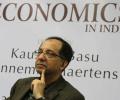
Former World Bank Chief Economist Kaushik Basu on Thursday said the US economic policy towards India has taken an unfortunate turn, noting that President Donald Trump's harsh stance against New Delhi appears baffling. US President Donald Trump on Wednesday announced a 25 per cent tariff on Indian goods from August 1, amid signs of a stalemate in the ongoing bilateral trade negotiations between the two countries.

North Block hasn't made a bureaucrat out of the chief economic advisor yet
Kaushik Basu became a headline hogger recently, but for what he says are all the wrong reasons.

Kaushik Basu, the C Marks Professor of International Studies, professor of economics, and director of the Center for Analytic Economics at Cornell, has been asked informally if he would consider becoming Chief Economic Advisor (CEA), a post that will fall vacant after Arvind Virmani ends his tenure and leaves to join the International Monetary Fund at the end of the month.

A Cornell University professor, Basu took over as the CEA in the Finance Ministry in December 2009 and his term ended in February. However, he was given extension till August as the government was in the process of formulating the proposals for the Budget for 2012-13.
Kaushik Basu, till recently the chief economic adviser of the government of India, who created a political firestorm in April when he said here on the sidelines of the World Bank/International Monetary Fund meetings that no economic reforms were likely in India before 2014 when parliamentary elections are due, has been appointed the World Bank's Chief Economist and Senior Vice President.

India's wholesale price-based inflation is at a 30-year high, leading to a "very alarming" situation for the country, former World Bank chief economist Kaushik Basu said on Thursday. He, however, doesn't see any risk of hyperinflation, but cautioned that if retail inflation follows wholesale prices, it might lead to "inflationary crisis". Participating in a virtual event organised by the Asia Society, India, Basu said the inflationary situation in India is at a "very risky bend".

"There are some pros and cons the RBI needs to keep in mind. The credit tightening, in terms of interest rates - we were expecting that was going to slowdown growth. We were expecting that was also going to slow down inflation. Unfortunately, what seems to be happening is, it is impacting growth and not having sufficient impact on inflation," Basu said.

Crude prices, which has become a big concern for the government fighting inflation, softened to about $104 to a barrel on the New York Mercantile Exchange after touching $107 a barrel, its highest level since September 2008.

Recently, Prime Minister Manmohan Singh had also ruled out the possibility of India witnessing a repeat of the 1991 balance of payments crisis and reversing the path to globalisation of economy.

'The song in Stree was written in the script... So it was not like some other films where it suddenly cuts to a song. This song moves the story forward.'

The finance ministry on Thursday said the 9 per cent growth projection for this fiscal may have to be revised on account of the high global commodity prices and the ongoing debt crisis in Europe.
Chief Economic Advisor Kaushik Basu says 9 per cent growth for the next financial year is 'well within target'.

Noting that India's inflation record was 'much, much better' against emerging economies, Basu said inflation should go down from September and as per expectations and calculations of the Finance Ministry, it will go below seven per cent from September.

Allowing futures trading in commodities will not fuel inflation, government's chief economic advisor Kaushik Basu said on Wednesday.
S&P earlier this week had said India faces 'one-in-three' chance of rating downgrade in the next two years

Inflation will continue to fluctuate over the next three months before it starts falling steadily, chief economic advisor with the finance ministry Kaushik Basu said on Friday.

Chief economic advisor Kaushik Basu on Thursday said that inflation may come down to 6 to 7 per cent in the next three months and that there was no need for any capital controls to check inflows as have been at a comfortable level.

India has been growing nine per cent plus before the global financial meltdown of 2008. The growth rate in 2011-12 slipped to nine-year low of 6.5 per cent.

Supporting the industry ministry's proposal to set up a sovereign wealth fund to finance infrastructure projects, Chief Economic Adviser Kaushik Basu on Monday said India can use a part of its large foreign exchange reserves to create the fund.
Chief Economic Advisor Kaushik Basu sounded a warning bell at the Carnegie Endowment in Washington, DC, last week, saying that big-ticket reforms would probably have to wait to be carried out for the next government, after general elections in 2014.
Nation will not be immune to 2014-15 European banks debt obligations, says Kaushik Basu.

The government's Chief Economic Adviser, Kaushik Basu, on Wednesday said economic growth is expected to rise to 8.5 per cent in the fourth quarter, while inflation is likely to be significantly lower from May-end

Deepa Gahlot picks 10 Bollywood horror flicks to mark Friday the 13th.

The government will release revised growth estimates for the current financial year by the end of June.

The World Bank has appointed Indermit Gill, an Indian national, chief economist and senior vice-president for development economics at the multilateral development bank. "Indermit Gill brings to this role a combination of leadership, invaluable expertise and practical experience working with country governments on macroeconomic imbalances, growth, poverty, institutions, conflict, and climate change," World Bank President David Malpass said in a statement. His appointment will be effective September 1, 2022.

Paul Romer, a New York University professor and economist

In a major decision to bring petroleum products in line with market rates, the government on Friday freed petrol from all pricing controls and hiked diesel prices by Rs 2 a litre.
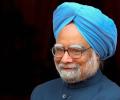
Former Prime Minister Manmohan Singh's 1991 budget unshackled India's economy, significantly enhancing the economic prospects for hundreds of millions of Indians, first deputy managing director of the International Monetary Fund (IMF) Gita Gopinath said on Friday.

'Demonetisation may have been well-intentioned, but it was a major mistake. The government should reverse it. It could at least declare that Rs 500 notes, which many poorer people frequently use, are legal again,' Basu, who till recently was World Bank vice-president, wrote in an opinion piece in The New York Times.

Stars go for the loveliest holidays -- exotic locations with a lot of adventure thrown in. We bring you their travels in a special series.
As the United Progressive Alliance government desperately fights the perception of a policy paralysis, Finance Minister Pranab Mukherjee dismisses it with equal vehemence contending that the coalition was set on achieving higher economic growth.

His comments followed release of latest data showing food inflation at nearly four-year low of 4.35 per cent during the week ended December 3, reflecting a decline in prices of essential items like vegetables, onions, potatoes and wheat.
Has the experiment of appointing non-government economists worked?

Economic growth in the second quarter will be lower than the 8.8 per cent expansion witnessed in the first quarter, Chief Economic Advisor Kaushik Basu said on Monday.

Various corporate bodies from US and UK had cautioned that such tax proposals could dent India's image as an investment hotspot.
Addressing economists, investors and academicians in Washington, Basu said the fundamentals of the Indian economy are strong enough in the medium and long term to sustain a healthy growth rate of over 8 per cent.

Amid rising global commodity prices and high inflation, the government is likely to scale down India's GDP growth projection for the 2011-12 financial year next month from 9 per cent estimated in February, chief economic advisor Kaushik Basu on Friday said.

As farmers continue their protests demanding repealing of the three new laws, Kumar also emphasised that continued negotiations with protesting farmers is of course the way forward.

India's economic growth rate slipped to 6.9 per cent in the second quarter this fiscal, the lowest in nine quarters.
